By: Chris ⎜ Last updated




The Bergen Card covers public transport, museum entry, and a handful of restaurant discounts across Bergen and the surrounding region. Whether it's worth it depends on what month you're visiting and how many museums you plan to see. The full list of inclusions is on the Bergen Card website, but the list alone won't tell you whether it's a good deal for your trip. In short, if you visit during summer it's more difficult to get value out of the card than during winter. Read more on this and see our example calculation below.
The inclusions that matter
The full list on the Bergen Card website runs to over 30 museums and attractions. Most of them are small, niche, and not places you'd visit on a two or three-day trip. The handful worth paying attention to:
Transport. The card covers all Skyss buses and the Bybanen light rail across Vestland county, including the airport line. A single ride costs NOK 51 at 2026 prices, so the round trip from the airport covers about a fifth of a 48-hour card before you've done anything else.
KODE art museums are the single biggest variable. KODE is Bergen's best museum and one of the most expensive tickets in the city (NOK 200 in 2026). From October through April, the card covers it entirely. From May through September, you only get 25% off, which still leaves you paying NOK 150 out of pocket.
The Fløibanen funicular is half price on return tickets with the card, year-round. In summer that reduces a NOK 200+ ticket to around NOK 100. The discount only applies to return tickets, not one-way, and redeeming it with a digital card involves a rather cumbersome process. The Fløibanen funicular discount doesn't work at the ticket machines, the Fløibanen app, or the normal floyen.no booking page. If you have the digital Bergen Card, you have to go to floyen.no/en/bergencard and enter your card's unique reference code. Your Bergen Card must already be activated before the system lets you buy discounted funicular tickets, which means you can't pre-purchase them while planning from home.
Bryggens Museum and Gamle Bergen (Old Bergen Museum) are both free with the card year-round, and both normally carry substantial entry fees. Bryggens Museum is built on top of the archaeological dig from after the 1955 fire, with medieval foundations still in the ground and artefacts predating the Hanseatic traders. Gamle Bergen is an open-air museum of 50-odd reconstructed wooden houses. Two of the better museums in the city, and between them they cover a good chunk of the card's cost. See calculations below.
The Ulriken cable car gets only 10% off with the card, which on a NOK 400+ ticket barely registers.
Bergen Aquarium and VilVite science centre follow the same seasonal pattern as KODE: free in winter, 25% off in summer.
The maths: A 48-hour visit at 2026 prices
This is based on our 2 Days in Bergen itinerary, which runs for 2 packed days and covers Fløyen, Bryggen, KODE, Ulriken, and either Gamle Bergen or Troldhaugen. The 48 hour card is 500 NOK and the potential savings depends, as mentioned, on the season.
Summer (May through September)
Without the card, you're paying individually for the Bybanen from the airport (NOK 51), a Fløibanen return (NOK 200 to 220), Bryggens Museum (NOK 170), KODE (NOK 200), Bybanen to the Ulriken area (NOK 51 each way), transport to Troldhaugen (NOK 51 each way), and the Bybanen back to the airport (NOK 51). That puts you somewhere around NOK 900 for one person.
With the card, all transport is included. Fløibanen costs NOK 100 instead of NOK 200. KODE costs NOK 150 instead of NOK 200. Bryggens Museum is free. Your total is the NOK 500 card plus around NOK 250 in discounted attractions, roughly NOK 750.
Summer saving: around NOK 150 per person. The saving is real but tight, and assumes 2 packed days with several museums. Drop a museum from the plan and you barely break even. You need to be visiting multiple sites per day to come out ahead.
Winter (October through April)
KODE becomes completely free with the card, saving an additional NOK 150. Winter saving lands around NOK 300 to 400 per person, with this itinerary, and you'll have covered the card cost within the first day.
Additionally, if you add on VilVite (normally NOK 240 but free in winter with the card) or the Bergen Aquarium (free November through February with the card) and the total without a card climbs well above NOK 1,000 while your card costs stay flat at NOK 500 for 2 days. Realistically though you might have to add on one more day to fit in all of this.
Winter therefore flips the equation. Since KODE, VilVite, and the Bergen Aquarium are all fully covered by the card, you can recoup the cost of the card with the airport transfer and a couple of museums. But you need to be aware that opening hours shrink for most attractions, with some museums only running from late morning to mid-afternoon, and a lot of institutions close on Mondays entirely. KODE is open Tuesday-through-Sunday from mid-September to mid-May. VilVite also closes on Mondays in winter. The University Museum is closed Mondays year-round.
2 Days in Bergen: The Insider´s Itinerary

Bergen is small. You can walk from one end of the centre to the other in twenty minutes. But still it´s easy to waste time by crossing the same ground several times. This plan keeps you moving in roughly one direction each day. Day 1 covers Fløyen, Bryggen, and the museums on the waterfront. Day 2 takes you up Ulriken, through the local neighbourhoods most tourists skip, and out to the edges of the fjord landscape.
How the Bergen Card works
Buy the digital version at visitbergen.com and you'll get an email with a QR code that you scan the first time you use it at an attraction entrance or on a bus. That first scan starts a rolling countdown. Activate a 48-hour card at 2 PM on Tuesday and it expires at 2 PM on Thursday, which means you can make use of it on three calendar days if you activate in the afternoon and squeeze in a museum on the morning of day three.
The card comes in four durations: 24, 48, 72, and 96 hours. At the time of writing 24 hours cost 400 NOK and each additional day is an extra 100 NOK. Hence it is difficult to get much value out of a 24 hour card. Going from 24 hours to 48 costs about the same as two bus rides, so the upgrade pays for itself if you use any public transport on the extra day. You need wifi or mobile data at the moment you activate, but after that the QR code works offline. Physical cards are available at the Tourist Information office on the Fish Market if you'd rather not depend on your phone.
2026 Renovations
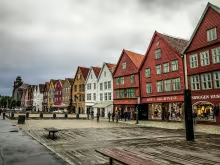
The Hanseatic Museum (Finnegården) on Bryggen is closed for a major foundation restoration until 2027. Everything has moved to the Schøtstuene assembly rooms nearby. You can see it on a guided tour (included in the ticket), but the cramped merchant living quarters inside Finnegården, which is what most people picture when they think of the Hanseatic Museum, are closed.
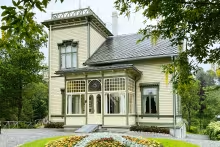
Troldhaugen, Edvard Grieg's lakeside villa, is closed for renovation until summer 2026. The concert hall, exhibition centre, café, and grounds are still open, but the villa itself is the reason most people make the trip. Getting out there takes close to an hour round-trip on the Bybanen plus an uphill walk, so check whether it's reopened before going.
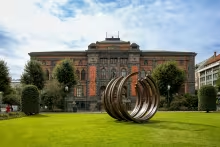
KODE Lysverket is closed for renovation targeting a reopening before summer 2026. KODE Rasmus Meyer is the one you want to visit anyway for the Munch collection and golden-age Norwegian art, and your ticket still covers all the other KODE museums.
When to Skip the Bergen Card
If you're stepping off a cruise ship for half a day, walking Bryggen and riding the funicular, there is absolutely no use for the Bergen Card.
The same if you plan to spend most of the time outdoor hiking. If you're spending the day on the Vidden trail between Ulriken and Fløyen, or hiking the Sherpa Steps on Ulriken, the card has no value.
Beyond the City Centre: Regional Transport
The card covers all Skyss buses across Vestland county, not just the city centre routes. For a standard two-day visit this mostly means convenient rides to Gamle Bergen, Ulriken, Troldhaugen and around the harbour neighbourhoods, but for longer stays with a 72 or 96-hour card, the regional reach gets more useful.
Bus 930 runs from Bergen Bus Station to Odda, three hours south, with a ferry crossing between Tørvikbygd and Jondal that's part of the Skyss network and covered by the card. Odda is the basecamp for Trolltunga. You can't day-trip that hike (10 to 12 hours on the trail), but the card covers the bus fare both ways, which on a multi-zone regional route would normally be expensive.
Bus 950 to Voss is technically free with the card too, but the bus runs once daily in the late afternoon. The Vy train does the same trip in 75 minutes with departures throughout the day, so most people end up paying for the train anyway.
The card only covers Skyss services. Vy trains, the Flybussen, and express coaches are not included. If it's not a Skyss bus or the Bybanen, you're paying separately.
Where to stay in Bergen: a neighbourhood guide
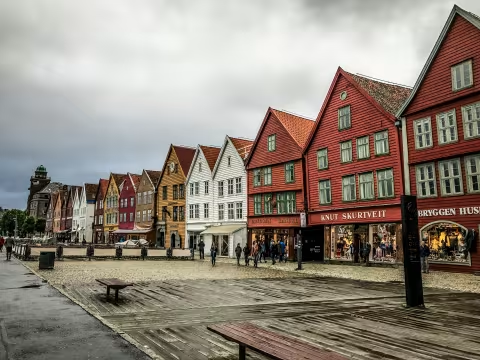
Bergen wraps itself around a single harbour. This makes choosing where to stay simple, you will stay in or close to the city center, but where? Every neighbourhood on this list is within walking distance of Bryggen, the fish market, and the Fløibanen funicular. The difference is atmosphere, not access.
9 of the best restaurants in Bergen, and what to order (2026)

Bergen has three Michelin-starred restaurants, a legendary hot dog stand that's been grilling since 1946, and a 96-year-old fish cake recipe that was once shipped weekly to Norwegian embassy staff in Paris. You can still waste a lot of money eating badly here if you wander into the wrong place though, as Bergen is expensive. What follows will stop that from happening. Here´s a selection of 9 of the best restaurants in Bergen at all price points.